
🌿 Casting with Nature: Extracting and Molding Lignin Bio-Composite for Sustainable Design
- Gavin Lottering
- Dec 23, 2025
- 3 min read

In the era of climate change and plastic pollution, the demand for sustainable materials is surging. Enter lignin — one of the most abundant, yet underutilized natural polymers on Earth. When combined with sawdust, it becomes a powerful, moldable, and fully biodegradable composite. This blog post explores how you can extract lignin from wood, blend it with sawdust, and cast it into a mold to create eco-friendly objects, ranging from artistic sculptures to biodegradable containers.
🔬 What Is Lignin?
Lignin is the aromatic polymer found in the cell walls of plants, giving wood its rigidity and resistance to decay. It’s often discarded during paper or biofuel production, but when isolated, it becomes a versatile, brown, sticky, resin-like substance — perfect for making biodegradable composites.
Combined with sawdust, lignin can act as both binder and filler, forming a castable bio-composite with surprising strength, texture, and workability.

💡 Why Use Lignin Bio-Composites?
Here’s why this material is worth your time:
Benefit | Explanation |
♻️ Biodegradable | Breaks down naturally without synthetic pollutants. |
🧪 Chemically Active | Lignin can bind dyes, metals, or even function in filtration. |
🧱 Moldable | Can be cast into any shape with minimal equipment. |
🔥 Thermally stable | Tolerates moderate heat (up to 200°C+ once cured). |
🌲 Waste-based | Made from byproducts like sawdust and wood shavings. |
🧪 How to Extract Lignin (DIY-Style)
Lignin extraction can be done at home (cautiously), though industrial methods are more efficient. Here's a basic acid-precipitation method you can try:
Materials:
Sawdust (oak, maple, fir — hardwoods are rich in lignin)
Sodium hydroxide (NaOH) or baking soda (mild alternative)
Vinegar or dilute sulfuric acid
Water
Pot, stove, funnel, filter paper or cheesecloth
Procedure (Simplified Kraft-Like Method):
Boil sawdust in a 5% NaOH solution for 1–2 hours (this breaks down cellulose and hemicellulose).
Filter the dark liquid (called “black liquor”) to remove solids.
Acidify the black liquor by slowly adding vinegar until pH < 5 — lignin precipitates out as a brown solid.
Filter and rinse the lignin.
Dry it into a powder or paste, depending on how you’ll use it.
⚠️ Safety Note: Work in a ventilated area and wear gloves/goggles — sodium hydroxide is caustic.
🛠️ Making the Lignin–Sawdust Bio-Composite
Once you've extracted lignin, you’re ready to make the composite.
Ingredients:
Dry lignin powder or paste
Sawdust (medium to fine texture)
Optional: water, starch, or citric acid (for binding/hardening)
Optional: dyes, pigments, essential oils
Ratio (approximate):
2 parts sawdust
1 part lignin paste
A few drops of water (just enough to bind)
Mixing:
Mix thoroughly until it forms a clay-like consistency.
You can also blend in fibers (hemp, flax, cotton) for strength or texture.
🧱 Casting the Composite
What You’ll Need:
A mold (silicone, wood, 3D-printed PLA, etc.)
Press or weights (optional)
Oven or air-drying area
Steps:
Prepare the mold: Apply a thin coat of oil or wax if needed to prevent sticking.
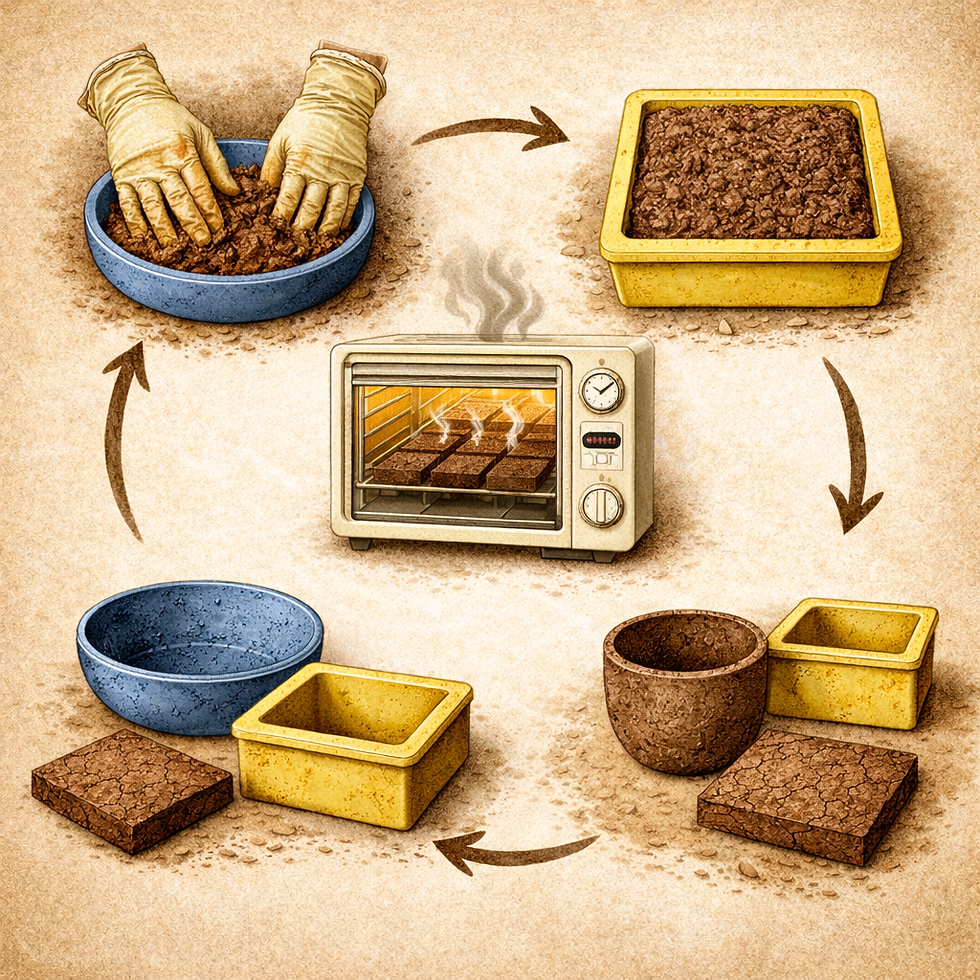
Pack the lignin–sawdust mix into the mold tightly.
Optional: Compress with a press or by hand to reduce air pockets.
Cure:
Air-dry for 24–72 hours, or
Bake at 90–120 °C for 1–2 hours to harden and cure
The result? A solid, wood-like object with a rich, earthy appearance — usable as a sculpture, bowl, filter element, planter, or experimental building material.
🔬 How Strong Is It?
Once cured, the lignin bio-composite is:
Water-tolerant (though not waterproof without treatment)
Sandable and paintable
Compostable over time
Capable of handling light structural loads (think frames, tiles, coasters)
To increase strength or waterproofing, try:
Crosslinking (add citric acid, starch, or shellac)
Surface sealing with beeswax, shellac, or natural resin

🎨 Creative & Practical Applications
You can use this composite for:
Application | Description |
🪴 Biodegradable pots | For seedlings or houseplants |
🧱 Tiles & panels | Interior design, wall art |
🖌️ Sculpture | Molds beautifully, takes on pigments well |
💧 Water filters | As part of a multilayer filter (with biochar or mycelium) |
🧴 Eco-packaging | Mold trays or inserts that degrade after use |
🌍 Final Thoughts: Casting a Better Future
Casting with lignin bio-composites is a compelling blend of science, art, and sustainability. You're using waste to build form — literally turning trees into usable, compostable objects without the need for fossil-based plastics or resins.
Whether you’re a maker, designer, chemist, or sustainability advocate, this material opens doors to new forms of creation that respect nature’s chemistry.



Comments