
🌿 Lignin Bio-Composite: From Filter to Fungi-Form
- Gavin Lottering
- Dec 23, 2025
- 3 min read

Using Lignin for Disposable Water Purification & Mycelium-Based Design
As the world turns to sustainable materials to reduce reliance on petroleum-based plastics, lignin — one of the most abundant natural polymers on Earth — is emerging as a low-cost, biodegradable solution. When combined with sawdust, it forms a moldable, porous material known as Lignin Bio-Composite (LBC).
In this post, we explore two groundbreaking uses of LBC:
As a single-use, compostable water filter, and
As a substrate and mold for growing mycelium-based objects.
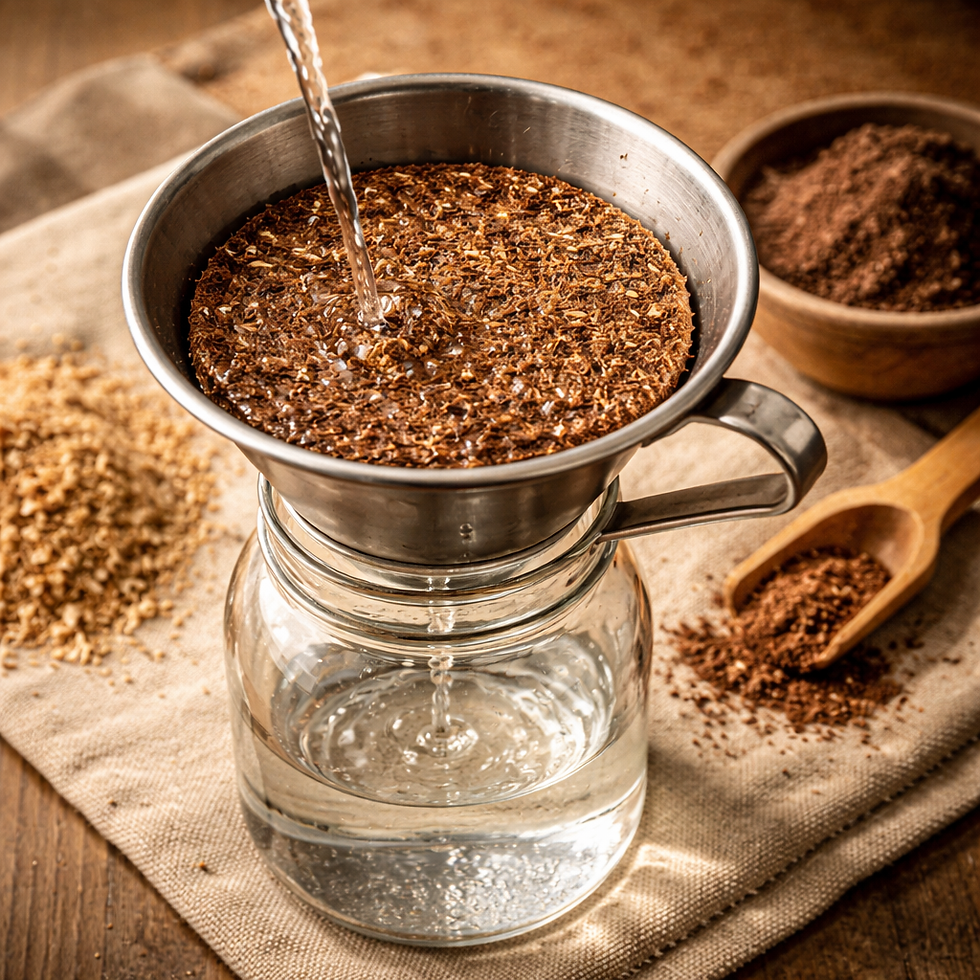
💧 Part 1: A Disposable Lignin Bio-Composite Water Filter
Why Use LBC as a Water Filter?
The porous, fibrous structure of lignin bio-composite gives it:
The ability to physically trap particles and sediment
Chemical affinity for binding some heavy metals and organic compounds (thanks to phenolic and hydroxyl groups)
A biodegradable lifecycle — the filter can be composted after use
This makes LBC a strong candidate for pre-filtration, rainwater filtering, or as a layer in multi-stage filters for emergency, outdoor, or off-grid use.
How to Make One:
🛠 Materials:
Lignin paste (extracted using an alkaline method from sawdust)
Sawdust or fine wood flour
Optional: biochar, clay powder, starch for added filtration
A mold in the shape of a disk or cone
Oven or air-drying setup
🧪 Steps:
Mix lignin and sawdust (2:1 ratio) into a moldable paste.
Shape into a thin disk or funnel that fits into a filter housing.
Cure at 90–120 °C until rigid and dry.
Use it to filter non-potable or rainwater — it can remove sediments, some heavy metals, and aromatic organics.
Once clogged or used up, discard it into compost — no plastic, no waste.
🔬 For advanced filtration: add biochar to enhance adsorption or pair with a second stage like activated carbon.

🍄 Part 2: Using LBC to Grow Mycelium-Based Objects
Lignin bio-composite is more than just a filter — it’s also an excellent substrate and mold filler for growing fungi. Certain fungi, like white rot species, can digest lignin and cellulose while forming a strong, foam-like network of mycelium. This natural structure can be grown into furniture, packaging, sculptures, and structural parts.
Why Use LBC with Mycelium?
LBC provides nutrients for fungal growth (carbon from lignin, cellulose from sawdust)
The moldable nature of LBC allows it to fill complex shapes
As the fungus grows, it uses the LBC as both food and structural binder
The resulting object can be heat-cured, making it rigid, durable, and biodegradable

How to Do It:
🧫 Materials:
Prepared LBC substrate (moist, not cured)
Mycelium spawn (e.g., Pleurotus ostreatus or Ganoderma lucidum)
Sterile environment or cleaned workspace
Mold (cone, bowl, brick, chair component, etc.)
🌱 Steps:
Sterilize or pasteurize your LBC (steam or heat).
Inoculate it with mycelium spawn and mix gently.
Pack the moist mixture into a mold.
Let it grow in a warm, humid space (22–28°C, dark) for 5–10 days.
Remove & dry: once fully colonized, heat-kill the mycelium by baking (90–100°C).
Optionally, seal or coat with natural wax, resin, or shellac.
The final product is lightweight, durable, and compostable — a brilliant blend of material science and biology.

🧠 Why It Matters
These innovations point toward a future where materials are grown, not manufactured — and where waste streams become resource streams.
Feature | LBC Filter Disk | LBC + Mycelium Object |
Biodegradable? | ✅ Yes | ✅ Yes |
Moldable? | ✅ Yes | ✅ Yes |
Compostable? | ✅ Fully | ✅ Fully |
Replaces Plastic? | ✅ Filter cartridges | ✅ Packaging, containers |
DIY Friendly? | ✅ Very | ✅ With clean conditions |
🌍 Final Thoughts
Lignin bio-composites are more than just an experiment — they’re a platform for regenerative design. Whether you're filtering water or growing a chair, you're building with chemistry that trees invented — and we’re only beginning to explore what’s possible.
Ready to try it yourself?Stay tuned for how to design molds, grow filters with fungi, or even brand your own bio-based filter products.


Comments